
Cape Hatteras Lighthouse: A Sailor's Story of the Graveyard of the Atlantic
- LocationBuxton, Outer Banks, NC
- Current tower1870
- LightWhite flash every 7.5 seconds
- HeightAbout 198 feet
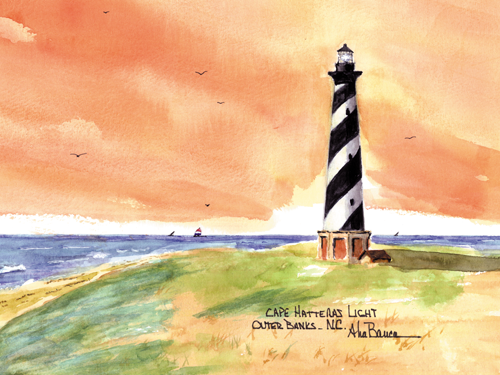
Cape Hatteras Lighthouse is the tallest brick lighthouse in America, and it stands watch over Diamond Shoals, the waters sailors call the Graveyard of the Atlantic. Alfred LaBanca painted its famous black and white spiral and wrote about the night two of his friends nearly lost their lives off this cape.
Hear more lighthouse stories
Alfred's lighthouse stories are also told on our Lighthouse Stories podcast. Press play below, or open the podcast on Spotify to hear the other lighthouses too.
The artist's story
Built in 1870, this magnificent treasure stands 191 feet tall, shows a white flash every 7.5 seconds and is visible for twenty-four nautical miles. The original light was built in 1803 and was only 95 feet high.
For good reason, Cape Hatteras ranks among the top places in the world that strike fear into a sailor's heart by the mere mention of her name!
A long time ago, before satellite weather reports, two friends of mine, Duke Stock and Ross Smith were moving Burl Ives' boat from Connecticut to Florida for the winter season. The boat, a beautiful, ninety foot yawl promised a pleasant cruise from north to south.
But, they ran into a nor'easter just off Hatteras and were almost killed trying to stay away from Diamond Shoals. They survived to tell how they lost control of the boat and were driven hard aground, broaching and snapping the masts. In the water, with debris raining down on them, they thought they were finished. Fortunately, some townspeople went into the surf and brought them to safety. The boat was a total wreck!
Incredible, this huge structure was moved out of harm's way in 1999 when it appeared that the ocean was going to claim her! Somehow they got this monument onto a flat bed with hundreds of rollers and sensors controlled by computers, and then moved it 2900 feet inland. It advanced so slowly that the eye had trouble seeing the movement.
In addition to the Hatteras Light, the Outer Banks has other great lighthouses, and is a must visit for people who connect with these "vanishing castles of America".
Alfred LaBanca, Sailor/Artist, Darien, CT
The Graveyard of the Atlantic
Off Cape Hatteras, the cold Labrador Current meets the warm Gulf Stream, and the sand of Diamond Shoals reaches miles out to sea. Fog, sudden storms and shifting shoals have sunk hundreds of ships here, which is how these waters earned the name Graveyard of the Atlantic.
The first Cape Hatteras lighthouse was lit in 1803, but it was too short and its light too weak, and sailors complained about it for decades. Congress paid for a new, much taller tower, and the lighthouse we know today was first lit in December 1870. At about 198 feet, it is still the tallest brick lighthouse in the United States.
The move of 1999
When the 1870 tower was built, it stood about 1,500 feet from the ocean. A century of storms ate the beach away, and by the late 1980s the surf was breaking only about 120 feet from its base.
In the summer of 1999 the National Park Service did something that had never been done with a tower this size. Engineers lifted the lighthouse onto a steel frame and rolled it, a few feet at a time, about 2,900 feet to its new home. As Alfred writes, it moved so slowly that you could hardly see it move, and it arrived safely that July. The keepers' houses were moved with it.
About the painting
Alfred LaBanca knew Hatteras as a sailor, and he painted the tower the way it greets you from the dunes: the black and white spiral climbing into a big Outer Banks sky. His Cape Hatteras watercolor is one of more than 200 lighthouse paintings in the American Lighthouse Art store. You can also see it on the Cape Hatteras Light page.
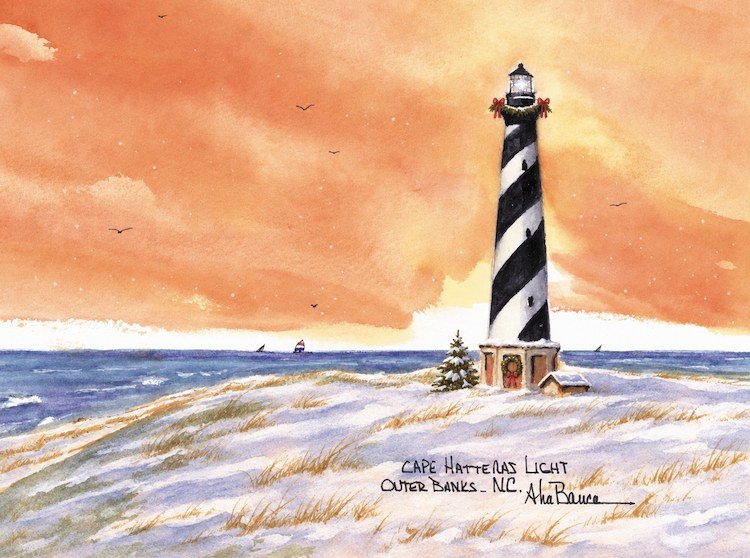
For the holidays, Alfred painted a snowy version with a wreath on the tower. It is one of our lighthouse Christmas cards, and a favorite for anyone who has vacationed on the Outer Banks.
Visiting Cape Hatteras Lighthouse
The lighthouse stands in Buxton, on Hatteras Island, inside Cape Hatteras National Seashore. The grounds, the keepers' quarters and the original 1870 foundation stones, which mark where the tower used to stand, are open to visitors.
In season the National Park Service offers climbs of the 257 steps to the top. Climbing days and hours change, and the tower has been closed at times for restoration, so check the National Park Service website before you go. Bodie Island Lighthouse and Currituck Beach Lighthouse are an easy drive north.
Cape Hatteras Lighthouse at a glance
- Location
- Buxton, Hatteras Island, North Carolina
- First lighthouse
- 1803
- Current tower
- First lit in 1870
- Height
- About 198 feet, the tallest brick lighthouse in America
- Light
- White flash every 7.5 seconds
- Daymark
- Black and white spiral
- Moved
- About 2,900 feet inland in 1999
- Managed by
- National Park Service, Cape Hatteras National Seashore
Bring Cape Hatteras home
Alfred's watercolor of Cape Hatteras is available as note cards, a matted print or a framed print. For the holidays, there is also a snowy Cape Hatteras Christmas card.
Questions about Cape Hatteras Lighthouse
How tall is Cape Hatteras Lighthouse?
The tower is about 198 feet tall, which makes it the tallest brick lighthouse in the United States. Its light shines about 191 feet above the sea.
Why was Cape Hatteras Lighthouse moved?
Beach erosion had brought the ocean to within about 120 feet of the tower. In 1999 it was moved about 2,900 feet inland to keep it safe.
Why are the waters off Cape Hatteras called the Graveyard of the Atlantic?
Diamond Shoals, strong currents and sudden storms off the cape have wrecked hundreds of ships over the centuries.
Can you climb Cape Hatteras Lighthouse?
In season the National Park Service offers climbs of the 257 steps. Hours change and the tower has been closed at times for restoration, so check the park's website before visiting.
Is there a Cape Hatteras Lighthouse Christmas card?
Yes. The Cape Hatteras Christmas card comes in packs of 8 for $18 or 24 for $49.90, with envelopes.